Every January, gyms sign up a wave of new members. By March, most of them have stopped coming. The membership did what it was designed to do. It opened the door. Whether anyone kept walking through it depended on things a membership can’t supply: a reason to show up, someone who expects you, feedback on your form and progress, and a routine that fits your week.
For the last few years companies have been handing out AI memberships to their own people. Copilot licenses. ChatGPT Enterprise. Agent platforms. Launch webinars and technical training. All of it opened the door. But in a lot of companies, the usage dashboard now looks like a gym sign-in sheet in March.
The usual fix is more technical training. At Hi, we think the real fix sits in two places:
- With the manager, the person who decides whether AI becomes part of how a team gets the work done, week after week. Managers sit in the middle, with new tools arriving almost daily and new direction coming down from leadership at a similar pace. Right now we see too many of them waiting for a clearly lit path before they act, rather than encouraging their teams to explore and making it safe to experiment.
- With the contributors, the team members interfacing with customers and workflows. What manifests as a technical knowledge gap is, in our experience, more about mindset and change management. The technical skills needed to effectively use AI tools are growing smaller, not larger. Once a user learns that they can use plain language prompts to ask their AI to write more sophisticated prompts, they are on their way. Their line manager is key to closing that gap, by setting expectations, giving feedback and supporting people as they start to experiment.
The flattening bet
In October 2024, Gartner predicted that through 2026, one in five organizations would use AI to flatten their structure and eliminate more than half of their middle management roles. Korn Ferry found that 41% of employees say their company has cut management layers, and 37% say they now feel directionless.
The appeal is easy to see. Agents can draft the status report and chase the follow-ups. But status reports were never the main job. The main job is helping people change how they work, and that’s what decides whether your AI investment pays off.
What the research says:
Microsoft’s 2026 Work Trend Index cites a Microsoft People Science survey of 1,800 workers (July 2025). When managers modeled AI use themselves, employees reported a 17-point lift in the value they got from AI, a 22-point lift in critical thinking about their AI use, and a 30-point lift in trust in AI agents. When managers made it safe to experiment, AI readiness rose by up to 20 points, and people were 1.4 times more likely to use agents often.
None of this should surprise anyone in L&D. Gallup has made the case since Marcus Buckingham and Curt Coffman’s First, Break All the Rules (1999), and its research shows that managers account for at least 70% of the variance in employee engagement.
The manager’s job has already changed
Earlier this year, Julia Shin and Sandra Sucher reported in Harvard Business Review on what they saw inside two consulting firms as AI spread. Junior staff got faster. Their managers took on the job of catching AI’s mistakes and checking its output, with no change in title or role to match. Most companies have handed managers a new job without telling them, training them, or giving them time to do it.
At Hi, we describe that job this way. A manager now leads three kinds of work at once. Some of it is still human work, done by people using their own judgment. Some is delegated work, handed to an agent. More and more is augmented work, where a person and an agent do it together. The basics of management still apply to all three: set expectations, manage performance, and build judgment. Two things change. The pace is faster than anything most of us have managed, and the span is wider, because a manager now oversees people plus everything those people are building in AI-accelerated environments.
That raises questions: What does good look like when an agent wrote the first draft? Who owns the result when the agent gets it wrong? When do you trust the output, and when do you check it? How do you review someone whose best work this quarter is an agent she built?
What good managers do differently in an AI-enabled world
They go first, in public. They use AI in front of their teams and alongside them, including the attempts that flop. In the Microsoft data, this one behavior was linked to higher value, critical thinking, and trust.
They decide what goes where, with their teams. Together they sort out which work stays human, which work goes to an agent, and which work gets done together. Then they revisit it as the tools and the team’s skills change.
They set the bar. Anything that leaves the team gets a human review, and the person who sends it owns it. People move faster, and with more confidence, when they know the standard.
They protect time to experiment. A regular hour to rebuild one piece of work with AI, with no penalty when it doesn’t work out. In Microsoft’s survey, only 13% of AI users say they are rewarded for trying new ways of working with AI when it doesn’t pay off. This is where great managers are key. They create the environment where experimentation and managed risk-taking are encouraged and rewarded. They also coach judgment along with usage. “How do you know this is right?” is a better question than “Did you use Copilot this week?”
They follow up. The weeks after a training session decide more than the session itself. A manager who asks “What did you try?” at week three does more for adoption than another webinar.
Two managers, same membership
Picture two managers at the same company, with the same licenses and the same training. This is a composite, but you’ll recognize both.
- Dana forwarded the rollout email and checks the usage dashboard once a month. Her team uses AI to tidy up emails, and nobody talks about it.
- Marcus opens each Monday meeting with something he tried that week, misses included.
Six months later, Marcus’s team has built agents nobody planned for, and they argue about AI output the way good teams argue about everything. Dana’s team still has the membership. Marcus’s team has built new habits.
What this means for L&D
If managers decide whether AI sticks, manager development belongs at the center of the AI plan from day one. So do the time and the permission to lead it, because the HBR research shows managers are already carrying the extra work.
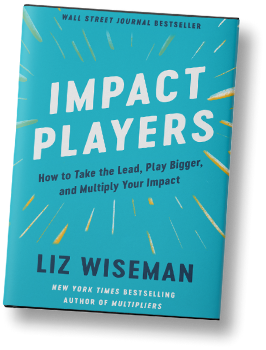
The other place the fix sits is with contributors. Hi’s Impact Lab builds on Liz Wiseman’s Impact Players research. It helps people do what the best contributors do when the target keeps moving: ask, adjust, and make the work lighter for everyone around them. It’s also designed to prompt a real conversation between each contributor and their manager, one that resets expectations and how they work together.
Like all our programs, Impact Lab is an experiential lab, with real work on your real AI tools. We plan for the 90 days after the session and measure what people build, how their confidence grows, and how their work changes.
Back to the gym
In a year or two, every company will have the same AI tools. What will separate them is whether people use those tools well, week after week. That depends most on the person they report to.
So before you cut that manager, or pile AI onto a job that’s already full, ask who will help your people make AI part of how they work. Like the gym membership, an AI license gets people started, and whether they keep coming back depends on their manager.
If you want to see what this looks like for your managers, let’s talk.
Sources
- Microsoft, 2026 Work Trend Index Annual Report: Agents, human agency, and the opportunity for every organization (May 2026)
- Microsoft People Science, “Research Drop: Empowering Managers for an AI-First Future,” Microsoft Viva Blog (November 11, 2025)
- Gartner, “Gartner Unveils Top Predictions for IT Organizations and Users in 2025 and Beyond” (October 2024)
- Korn Ferry, Workforce 2025: Power Shifts (2025)
- Julia Shin and Sandra J. Sucher, “AI Adoption Is Overloading Your Middle Managers,” Harvard Business Review (June 26, 2026)
- Gallup, “Employees Want a Lot More From Their Managers,” Jim Harter and Amy Adkins (April 2015)
- Marcus Buckingham and Curt Coffman, First, Break All the Rules: What the World’s Greatest Managers Do Differently, Gallup Press / Simon & Schuster (1999)