When output gets cheap, judgment gets expensive.
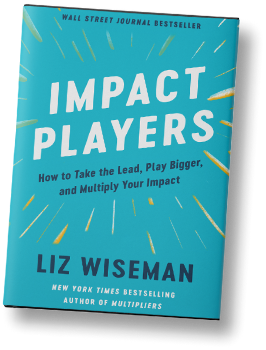
Liz Wiseman published the research behind Impact Players in 2021, a year before most of us had ever typed a sentence into ChatGPT. Her team studied contributors across 170 organizations and asked the managers a simple question: who creates the most value, and how? The answer came back as a number. The people they called impact players delivered more than three times the value of a typical contributor, and close to ten times that of an under-contributor.
That number was set in a world without AI. What happens to a 3x performer when you hand them a tool that rewrites the cost of getting work done?
Our estimate is somewhere between four and five times the impact of a standard performer who hasn’t embraced AI. But the multiplier isn’t where this story lives.
What AI actually does to the work
Start with what AI changes. It makes execution cheap. Drafting, summarizing, researching, coding a first pass, modeling a scenario, building the deck. The cost of the how in knowledge work collapses almost overnight. What it does not touch is the judgment about which work is worth doing at all.
That sounds like it should help everyone equally. It doesn’t.
When execution was expensive, it acted as a ceiling. Even your best people could only apply their judgment to so many problems in a week, because most of their hours went into producing the work rather than deciding what work mattered. The impact player’s real gift, knowing what’s important now, framing the right problem, and finishing the thing, was rationed by how fast they could type, build, and analyze.
AI lifts that ceiling. The same judgment now reaches two to three times the surface area. Microsoft’s 2026 Work Trend Index found that among its heaviest AI users, 80% say they’re producing work they couldn’t have produced a year ago. That’s scope, not speed.
Why the impact player pulls away instead of leveling off
The research seems to cut the other way. Study after study finds that AI helps the least experienced people the most. Harvard and BCG put 758 consultants through GPT-4, and the below-average performers improved 43%, against 17% for the top group. A Stanford-led study of more than 5,000 customer-support agents found a 34% jump for novices and almost nothing for the experts. AI compresses the gap. So shouldn’t it erase the impact player’s edge rather than widen it?
That would be true if the impact player’s edge were execution. It never was.
Those studies measured task speed, how fast someone closes a ticket or drafts a memo. Wiseman’s 3x was about judgment, initiative, ownership, and reading what the moment actually needs, never about speed. AI commoditizes the first thing and makes the second thing scarce. When everyone can generate a competent draft in seconds, the rare and valuable skill is knowing which draft is worth pursuing, what good looks like, and what to throw away.
The same BCG study makes the danger concrete. On a task designed to sit just outside AI’s competence, consultants using AI were 19 points more likely to get it wrong, because the model produced confident, polished, plausible work that happened to be false. AI fails silently. The person who catches it is the one with the judgment to know when not to trust the machine. AI hands the average user a loaded gun. It hands the impact player a force multiplier.
The five practices, applied to more of everything
Wiseman’s framework and AI fit together closely here. She found five practices in impact players: doing the job that’s needed, stepping up and stepping back, finishing stronger, asking and adjusting, and making work light. Every one of them was bottlenecked by capacity. You can only do the job that’s needed for so many problems before you run out of day.
AI removes the capacity limit on every one of them. The person who spots what’s important now can chase ten of those signals instead of three. The one who finishes stronger can carry more threads to completion. And the most underrated effect: Brynjolfsson’s research found that AI tends to disseminate the best practices of the highest-ability workers to everyone else. For Wiseman that lands hard, because she measures impact on the organization, not the individual. The impact player isn’t only multiplying their own output. Their way of working becomes the pattern the AI encodes and spreads, and they lift the people around them.
What it looks like at one desk
Picture two analysts on the same team, handed the same AI tools on the same Monday. The first uses them to do what she already did, faster. More decks, more first drafts, a fuller outbox by Friday. Useful, and her manager notices.
The second uses the same hour differently. She lets the model generate five approaches to a stalled problem, throws out four, and spends the time she saved on the one customer question nobody had framed yet. By Friday she hasn’t produced more pages. She’s changed what the team is working on. Same tools, same team, and only one of them moved the needle, because only one of them was ever going to.
The limit
Put an impact player next to a standard performer who has also fully embraced AI, and the gap narrows. The floor rises for everyone. AI is a real equalizer on execution.
Which is exactly why the durable advantage lives somewhere else. In an AI world, the impact player traits (judgment, initiative, ownership, and knowing what matters) stop being one differentiator among many and become the only one that survives. Everything AI can do, it will eventually do for everybody. What’s left is the human work of deciding what’s worth doing. That’s the part you can’t download.
The bottom line
Wiseman proved impact players deliver more than 3x, in a world before AI existed. AI doesn’t replace that edge. It removes the ceiling that capped it. As competent output gets cheap, judgment becomes the scarce asset, and the impact player’s multiplier compounds instead of fading.
Four to five times the impact isn’t a promise about the tool. It’s what happens when the rarest kind of contributor stops being rationed by how fast they can execute. The tool raised the floor for everyone. The ceiling is now a choice.
Sources:
- Liz Wiseman, Impact Players: How to Take the Lead, Play Bigger, and Multiply Your Impact (Harper Business, 2021)
- Dell’Acqua, Mollick, et al., Navigating the Jagged Technological Frontier, Harvard Business School / BCG, 2023 (published in Organization Science, 2025)
- Brynjolfsson, Li, & Raymond, Generative AI at Work, NBER w31161 / Quarterly Journal of Economics, 2025
- Microsoft, Work Trend Index, 2026